Pew Report: Religious Faith Stabilizing in America
Many assume that America is an increasingly secular society, with a shrinking view of faith and religion. This might have been true many years past, and there seems to be a strong case that could be made for this assumption based on real-life anecdotes that we all see.
But a new Pew Research Center report indicates this is not correct. Researchers explain, “After a prolonged decline, religion in the United States has shown signs of strength and stability in recent years.” Pew finds that since the dawn of this decade, the number of adults who say they identify with some form of religious faith, pray daily, attend services at least monthly, and admit their faith is “very important” in their lives has stabilized.
The report does not mention anything specifically about Christianity. But given that Pew has consistently reported that a sizable majority of Americans, most recently 62%, identify as Christians, we can reliably deduce that the strong majority of this stabilization is among those who consider themselves Christians or are investigating Christianity.
Pew’s stabilizing data trendlines look like this:
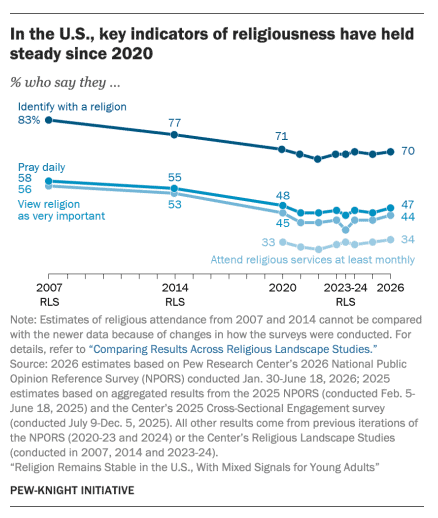
Pew also finds the number of people who said they participated in a religious service in person or electronically is the highest it’s been since they started asking this question in July 2020 during the height of the COVID-19 pandemic.
A curious finding for Pew is with age groups. The very youngest adults – ages 18 to 22 – “are reporting relatively high rates of attendance at religious services.” But slightly older young adults – ages 23 to 26 – “are the least religious age group when it comes to how often they pray, how important religion is in their lives and how many of them identify with a religion.” They are also the lowest of any age group, at 27%, when it comes to saying they have attended a religious service in the last month.
The youngest American adults are no more religious today than their peers were in 2014, Pew explains, but the 23 to 26 young adults are less religious than their 2014 peers.
Regarding political convictions, Pew notes, “When it comes to religion and politics among young adults, the youngest Republicans report attending religious services more often than the youngest Democrats, which is not unusual.” Daily Citizen has reported on the consistency of conservatives being more faith-oriented here.
Of course, being “religious” carries no weight with God. It is active faith in and obedience to Christ that matters. But it is not nothing that people practicing religious faith are holding steady for the most part. Most of these “religious” identified people are attending Chrisitan services or are interested in Christian teaching. Let us pray they are availing themselves of solid biblical teaching and preaching.
There is a strong indication that they are. It has been well-documented that while mainline liberal churches are tanking in attendance, evangelical churches have seen overall growth. Pew has reported that “the share of Americans who identify with nondenominational Protestantism is growing.”
Former New York Times columnist Ross Douthat touched on this in a recent piece for The Free Press where he asked, “Why Evangelicalism Is Winning.” He believes that evangelicalism, over all other faiths and Christian denominations, is best suited to remain the dominant and most influential faith movement enlivening American culture and its people. He says, “For all the buzz around a ‘Catholic century,’ evangelicalism is the denomination best placed to thrive in contemporary America.”
The Daily Citizen will continue to track the health and vitality of Christian faith in America.
Additional Resources on the Total Lordship of Christ:
Is Religious Faith Gaining Influence in America?
How Big is Your View of the Gospel?
The Cultural Paradox of Following Jesus Christ
The Church’s Lane is the Whole Cosmos
Is Biblical Christianity on the Decline?
Appreciating the Full Scope of the Lordship of Christ – and the Gospel Itself
As Secularists Prep for the Apocalypse, Christians Must Have Strong Kingdom Theology
More Young Adults Turning to Faith After Pandemic, Study Finds
In Our Troubled World, Take Heart and Remember That Christ is King


ABOUT THE AUTHOR