
Breaking Research: What Drives Couples to Have More Babies?
More and more people are becoming aware that the number of human births is seriously tanking across most of the world. This fact creates great challenges for every country’s future prosperity and growth.
But not everyone is not having kids. Beliefs and attitudes matter significantly here.
For the last two decades, strictly-Orthodox Jews living in the New York City metro area averaged 7.5 babies born per woman. Their well-educated, native-born non-Hispanic more liberal white female neighbors had only 1.58 babies. Amish communities in rural Ohio average 6 children per woman. Ohio at large has below replacement fertility at just 2 children per woman.
Deciding against having plenty of children is certainly not a function of cost. Culture and personal beliefs matter greatly. An important new report from scholars at the Institute for Family Studies (IFS) and the Wheatley Institute explores the nature of these drivers of human fertility, and these insights are deeply needed given how fast global fertility is declining. This research report, entitled “Baby Nudges: How Social Influences Shape Fertility Choices,” explains how the make-up and nature of a couple’s social network can positively or negatively impact their lifetime fertility. In short, who we hang around with and allow ourselves to be influenced by has big consequences for the new people we bring into the world.
These scholars explain, “We know fertility is contagious, but we do not know exactly what is being ‘caught.’” They surveyed nearly 10,000 respondents from over a dozen countries, spanning the United States and the U.K., Japan, Israel, China and Korea, allowing this research team to provide “first-of-a-kind evidence” on what personal beliefs, behaviors and cultural norms lead to increased births in particular communities.
So, what did these scholars find?
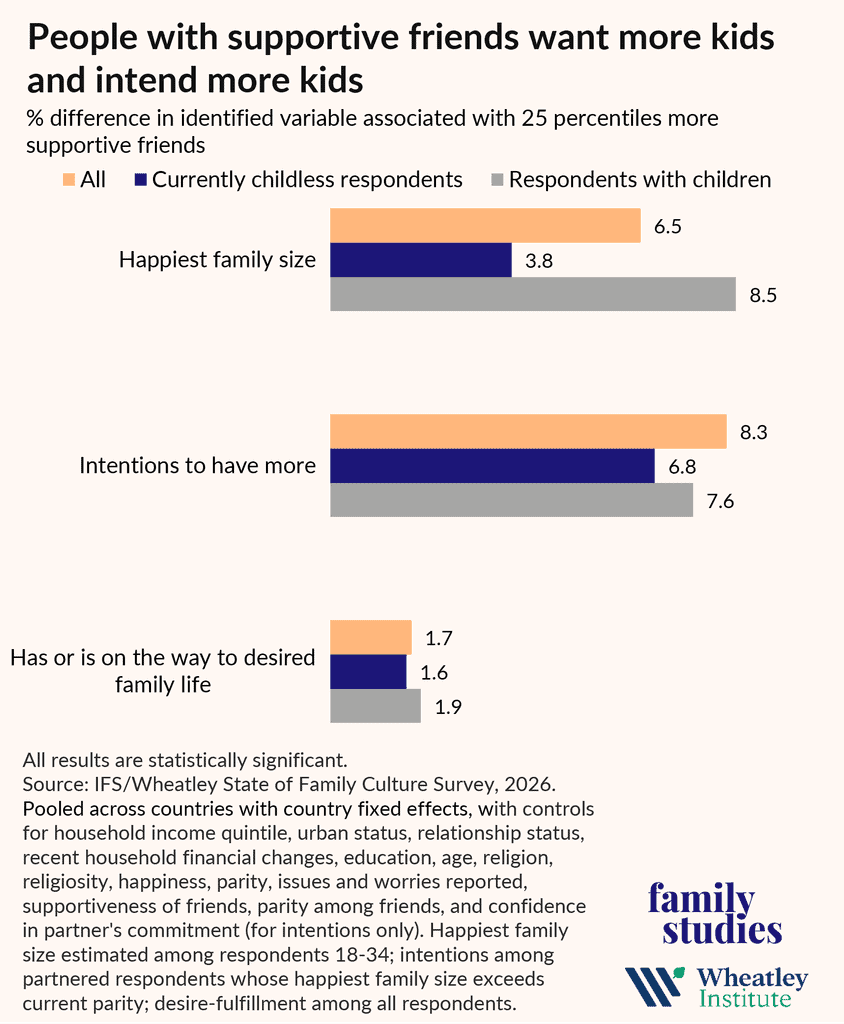
First, they explain, “We find resounding evidence that peers do matter to fertility.” Drawing from their poll and published academic literature, they report that “across cultures, perceptions of peer support for childbearing matter a great deal.” When a couple has friends who are having babies and support one another in having and caring for those babies, this translates into higher birthrates. A pro-natality mindset is positively infectious. Specifically, they explain:
Believing one’s friends would celebrate a new baby is associated with a 10% increase in desired number of children and a 20% increase in the likelihood of intending to have another child, while parental encouragement to have children is associated with an 11% increase in desired number of children and a 30% increase in the likelihood of intending to have another one.
Friends and parents matter a great deal. IFS’s data chart on this looks like this:
Active and seriously held faith is also a positive fertility driver. This report asserts,
Being in the top third of respondents in religiosity is associated with having 9% more children than other respondents, with positive effects showing up in many countries. This is also associated with desire for more kids (+15%) and a higher likelihood of intending to have another child (+12%).
Interestingly, this is “not driven by the frequency of pro-family statements from religious leaders but is more likely due to greater support and encouragement from family and other religious community members.” These scholars further explain, “Thus, while religious leaders promulgating pronatal norms may not always be very effective, religious communities that choose to support young families, create role models for joyful family life, inspire higher family aspirations, and motivate communities of mutual support among members, can be very effective at encouraging family formation.”
What is more, religious people tend to have more fertility-supportive friends. This is true all around the world, except curiously, in Ireland.
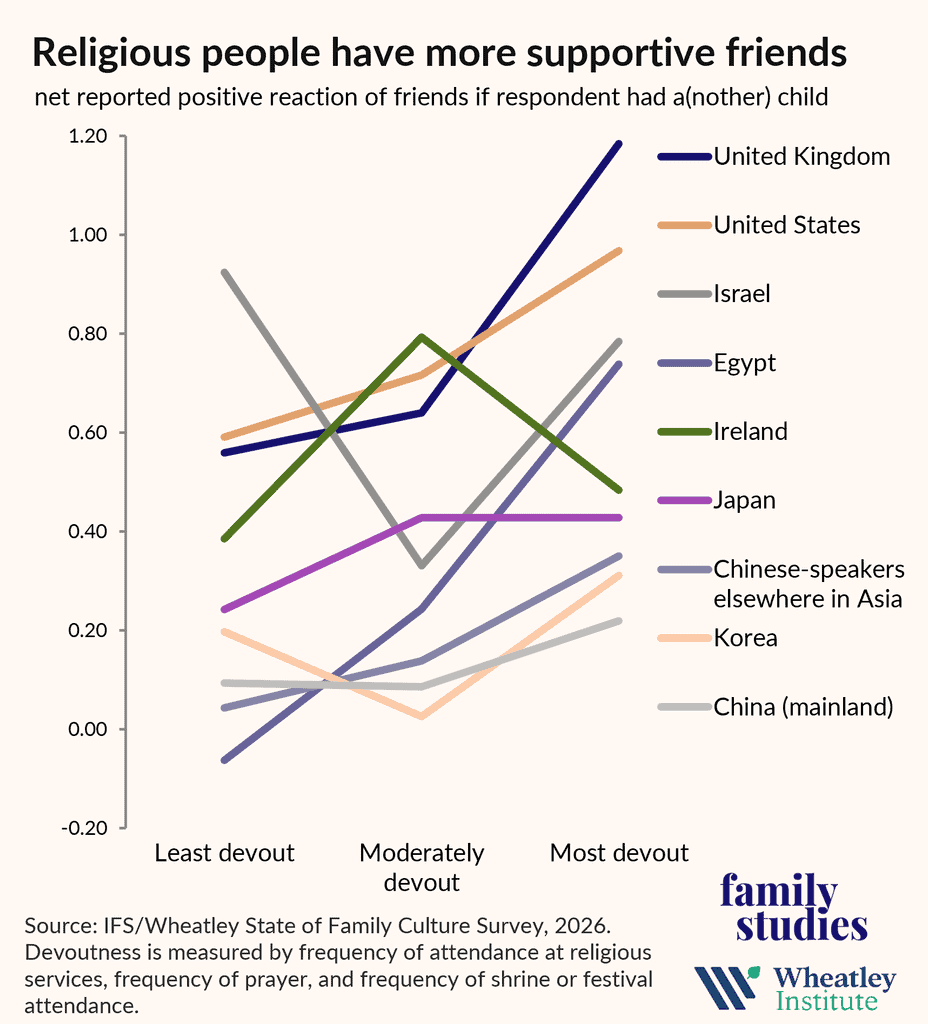
This largely translates into higher birthrates among such people because our friends and family members impact our behavior in powerful ways. And the Anglo and Middle Eastern worlds are far more likely to offer such help than Asia.
Surprisingly, these scholars also found that having a positive perspective on the future and being more willing to take risks – not captured by high levels of “safety-ism” – are related to having more children over couples who do not have these qualities.
They also document how well-promoted celebrity pregnancies can boost the fertility of others who follow these celebrities and this can be a global phenomenon. But celebrities who do not have children can also have an anti-natal impact. Humans tend to follow the examples of those we admire, even if we do not know them personally. This chart shows how this works out across select nations.
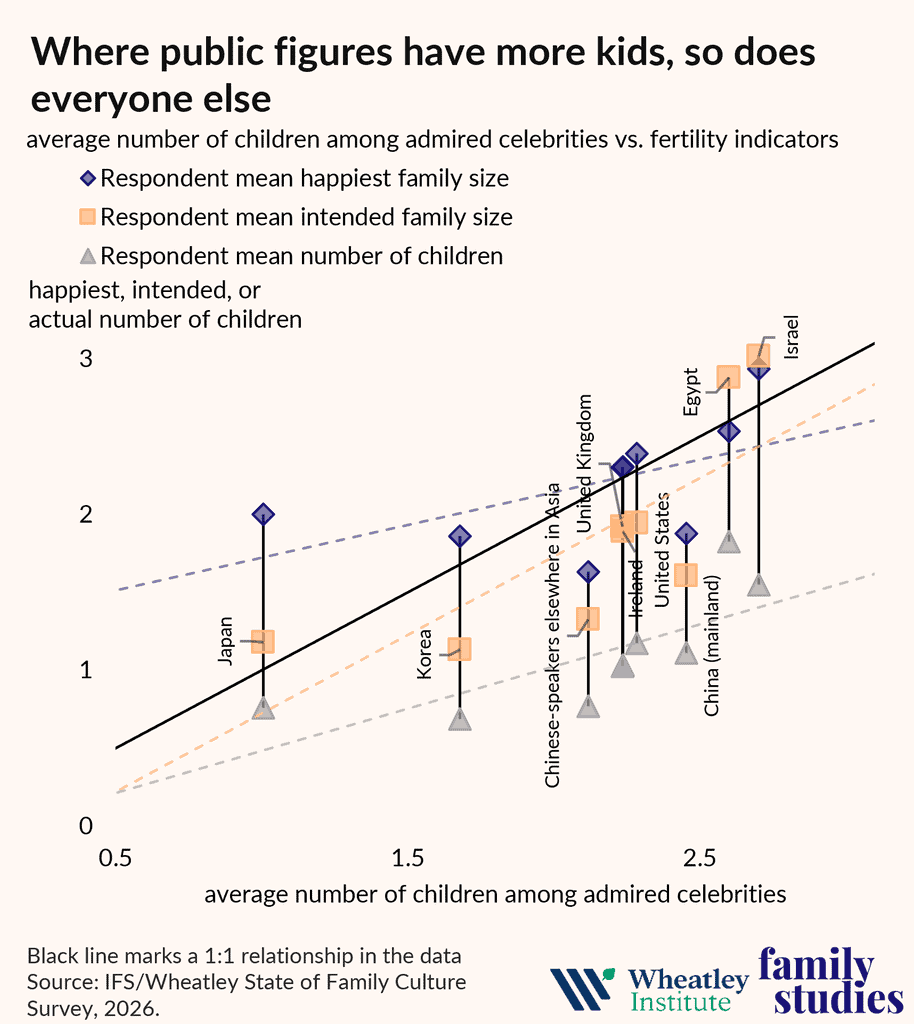
These scholars explain, “Simply put, the fertility and family patterns of celebrities, politicians, athletes, influencers, and other public figures are very likely to shape the desires, intentions, and – ultimately – the behaviors of their young admirers.”
Humans are social creatures. We are not as inclined to increase our fertility when government leaders offer financial and policy incentives. That is because the decision to have a first, second, or third child is not fully an economic consideration. Policy levers can help to small degrees and should be wisely pursued. This report says that policy makers would be wise to emphasize the truth that family life can indeed be a pleasant and joyful experience. After all, important IFS research does consistently demonstrate that married moms and dads are markedly happier than their unmarried and childless peers.
But having babies (or not) is a much more visceral decision driven by more personal factors, like the behaviors and norms of our peer group. Research is now indicating that the behaviors and attitudes of people around us really make the biggest difference.
So, if you think having babies is an essential human virtue, and it most certainly is, seek out friends who are in the midst of growing larger families, and doing it well. You can also become an encourager in this regard to others around you, as well. Baby-making is contagious.
Related articles and resources:
Fertility Decline is Widespread Across Education Levels
Troubling Fertility Decline: Fixed by Pagan or Christian Sexual Ethics?
The Pressing Need to Fix Global Fertility Decline and How to Do It
Married Mothers and Fathers Are Happiest According to Gold-Standard General Social Survey
New Family Study Shows Importance of Married Parenting
Is Inflation Driving Fertility’s Decline?
American Deaths to Exceed Births Faster Than Expected, CBO Reports
U.S. Fertility Rate Falls to Lowest on Record – Again
Global Population Has Passed ‘Peak Child’ – an Ominous Milestone